
Júlio Pomar
Júlio Pomar was born in Lisbon on January 10, 1926, and died on May 22, 2018, in the same city. He moved to Paris in 1963.
He attended the António Arroio School of Decorative Arts and the Schools of Fine Arts in Lisbon (1942–44) and Porto (1944–46), the latter of which he left after being suspended for disciplinary reasons related to student activities. Beginning in 1946, he was a member of the Central Committee of the Youth Democratic Unity Movement (MUD), an activity for which he was arrested the following year and convicted in court. In 1949, due to his involvement in Norton de Matos’s presidential campaign—for whom he drew a widely publicized portrait—he was removed from his position as a drawing teacher in technical education.
He exhibited for the first time in 1942, in Lisbon, as part of a group show held in his studio, and held his first solo exhibition in 1947, in Porto, at the Galeria Portugália, presenting drawings that would be published the following year in an album with a foreword by Mário Dionísio. Early in his career, he was one of the driving forces behind the neo-realist movement, contributing extensively to newspapers and magazines: “A Tarde” (a daily newspaper published in Porto, where he coordinated the weekly “Arte” page in 1945), “Mundo Literário,” “Vértice,” “Seara Nova,” “Horizonte,” “Portucale,” “Comércio do Porto,” etc. He participated in organizing the Independent Exhibitions in 1944–45 in Porto, and later in the Spring Exhibition (Porto, Ateneu Comercial, 1946), serving as one of the main organizers of the General Exhibitions of Fine Arts (National Society of Fine Arts, Lisbon, 1946–1956). In 1956, he was one of the founders and first members of the board of directors of the “Gravura” Cooperative.
After this initial period of establishing himself—marked by a strong emphasis on political intervention in the postwar context—Pomar’s painting shifted toward an observation of reality that questions the emergence of the image, depicting bodies in motion through a discontinuous and fragmentary figuration. This approach found its best-known expression in the series “Tauromaquias” (1960–64) and “Les Courses,” horse races (1964–66), exhibited in Paris at the Galerie Lacloche. Organized into thematic cycles marked by breaks or new formal languages, Pomar’s work continued with the cycles “Rugby,” “May ’68,” and “Le Bain Turc, d’après Ingres” (1967–73), with the Louvre Museum having exhibited a painting from this series as part of an exhibition dedicated to Ingres’s painting (1971).
A period dominated by portraits (1972–76—first exhibited at Galeria 111, Lisbon, in 1973), in which synthetic and emblematic forms are defined by planes of solid color, is followed by a shift toward collage techniques using cut-out and pre-painted canvases, sometimes incorporating found objects as well, which correspond to the erotic themes of the exhibitions “L’Espace d’Eros” (Galerie de la Différence, Brussels, 1978) and “Théâtre du Corps” (Galerie Bellechasse, Paris, 1979).
Among his most significant later series—in which a return to a vibrant pictorial gesturality is already evident—the following stand out: “The Tigers” (Paris, 1981; Lisbon, 1982) and new series of portraits inspired by Edgar Allan Poe’s poem “The Raven” and Fernando Pessoa’s “Mensagem” (1982–86). Trips to Brazil inspired the exhibitions “Os Mascarados de Pirenópolis” (1988, Lisbon and Madrid) and, following a stay in the Upper Xingu region of the Amazon, “Os Índios” (Madrid and Paris, 1990).
Literary themes—including, at times, an ironic reinterpretation of classical and biblical myths—are revisited in the works featured in the exhibitions “Fables et Portraits” (Galerie Piltzer, Paris, 1994) and “O Paraíso e Outras Histórias” (Culturgest, Lisbon, 1994), “La Chasse au Snark,” in very large-format canvases inspired by Lewis Carroll (Galerie Piltzer, Paris, and Salander-O’Reilly Gallery, New York, 1999–2000), and “Trois Travaux d’Hercule et quelques chansons réalistes” (Galerie Patrice Trigano, Paris, 2002), while his connection to the Amazon reappears in “Les Joies de Vivre” (Galerie Piltzer, Paris, 1997) and “Méridiennes – Mères Indiennes” (Galerie Patrice Trigano, Paris, 2004). “Fables et Fictions,” a series of new bronze sculptures, was exhibited at Galerie Le Violon Bleu in Tunisia in 2004.
The first retrospective of Pomar’s work was organized in 1978 by the Gulbenkian Foundation and exhibited at its headquarters in Lisbon, at the Soares dos Reis Museum in Porto, and, in part, in Brussels. In 1986, a new retrospective exhibition was also presented by the Gulbenkian Foundation at museums in São Paulo, Rio de Janeiro, and Brasília, and finally at the Center for Modern Art in Lisbon.
Among other thematic or chronological anthologies, the following are particularly noteworthy: in 1990, works on Brazilian themes, in Rio de Janeiro, São Paulo, and Lisbon (“Pomar/Brasil”); in 1991, paintings and drawings on literary themes and portraits of writers (“Pomar et la Littérature”), Charleroi, Belgium; in 1992–93, works from the 1980s, on a touring exhibition in Portugal; in 1997, works on the theme of Don Quixote in Cascais, and paintings of the Indigenous peoples of Brazil in Biarritz, France; in 1998, a graphic art exhibition that later toured nationally; in 2005, illustrations and works on literary themes in Tavira. Other retrospective painting exhibitions took place in 1999–2000, in Macau and Beijing; in 2001, in Aveiro (“Recent Paintings,” 1995–2000); and in 2003, in Istanbul and Amarante.
In 2004, the Sintra Museum of Modern Art – Berardo Collection presented a major retrospective titled “Pomar/Autobiography,” curated by Marcelin Pleynet, while the Belém Cultural Center exhibited the anthology “The Human Comedy,” organized by Hellmut Wohl to showcase the artist’s work from the most recent decades.
Pomar has devoted himself primarily to painting, but has also created works in drawing, printmaking, sculpture, and “assemblage,” as well as illustration, ceramics, glass, tapestry, theater set design, and tile murals. Among his commissions for public buildings, in addition to the frescoes painted at the Cinema Batalha (Porto, 1946–7)—which were concealed by order of the police—notable works include the tile murals for the Alto dos Moinhos station (1983–84), the Jardin Botanique in Brussels (1992), and Corroios (1998), as well as for the Gran’Circo Lar (Brasília, 1987) and the courtroom of the Moita Court (with architect Raul Hestnes Ferreira, 1993), and the tapestries created for the headquarters of Montepio Geral and Caixa Geral de Depósitos.
Among the numerous works he illustrated are Tolstoy’s “War and Peace” (1956–58); “The Novel of Camilo” by Aquilino Ribeiro (1957); “Don Quixote” by Cervantes (in 1960 and again in 2005); “The Divine Comedy” by Dante (1961, illustrations reissued in 2006 with new portraits of the author); “Emigrantes” and “A Selva” by Ferreira de Castro (1966 and 1973); “Pantagruel” by Rabelais (1967); “Kidama Vivila” by Gilbert Lely (1977); “Rose et Bleu” by Jorge Luis Borges (1978); “Mensagem,” by Fernando Pessoa (1985); “La Chasse au Snark,” by Lewis Carroll (1999).
Júlio Pomar was part of the Portuguese delegation at the 1953 São Paulo Biennial, participated in the Carnegie Institute’s International Exhibition in Pittsburgh in 1964, and again in the São Paulo Biennials of 1975 and 1985. The Calouste Gulbenkian Foundation, from which he received a fellowship in Paris between 1964 and 1966, awarded him the Printmaking Prize (tied) at its First Exhibition of Fine Arts in 1957, and the First Prize for Painting (jointly awarded) at the Second Exhibition of Plastic Arts in 1961. The FVG Foundation in Hamburg awarded him the Montaigne Prize in 1993. He received the AICA-SEC Prize in 1995, the Celpa / Vieira da Silva Prize in 2000, and the Amadeo de Souza-Cardoso Prize in 2003.
Among the various monographs on his work, the following are particularly noteworthy: the texts by Mário Dionísio (published by the authors, 1948; Clássica Editora, 1985; Publicações Europa América, 1990); Ernesto de Sousa (published by Artis, 1960); Helena Vaz da Silva (published by António Ramos, 1980); Jean Guichard-Meili and Wolfgang Sauré (Paris, 1981); Claude-Michel Cluny (Paris, 1985 and 1994); Fernando Gil (Imprensa Nacional, 1987); Michel Waldberg (Paris, 1989 and 1990); Marcel Paquet (Paris, 1991); Alain Gheerbrandt (Paris, 1997); Marcelin Pleynet (Paris, 1997, 1999, and 2004); António Lobo Antunes (Galeria 111/Pub. D. Quixote, 2002); Mário Cláudio (Caminho, 2007).
Other authors who have written about his work include, among others, Rui Mário Gonçalves, Fernando Pernes, Fernando de Azevedo, José Luís Porfírio, José-Augusto França, Manuel Castro Caldas, João Pinharanda, Alexandre Melo, José Cardoso Pires, Vasco Graça Moura, Eduardo Lourenço, Nuno Júdice, Antonio Tabucchi, Paulo Herkenhoff, Denys Chevalier, Roger Munier, Patrick Waldberg, Pierre Cabanne, and Gérard-Georges Lemaire.
The first two volumes of the “catalog raisonné” of his paintings and sculptures were published by Éditions de la Difference in Paris, featuring critical essays by Alexandre Pomar and Marcelin Pleynet (Volume I, 2004, co-published with Arte Mágica, Lisbon) and by Raquel Henriques da Silva and Michel Waldberg (Volume II, 2001).
In addition to numerous articles published in magazines and catalogs—both about other artists and his own work—Pomar is the author of the essay collections on painting *Discours sur la Cécité des Peintres* (Editions de la Différence, Paris, 1985), translated into Portuguese by Pedro Támen as “Da Cegueira dos Pintores” (1986, Imprensa Nacional); “– Et la Peinture?” (La Différence, 2000); and “Então e a Pintura?” (D. Quixote, 2003).
He has published two books of poetry: “Alguns Eventos” (D. Quixote, 1992) and “TRATAdoDITOeFeito” (D. Quixote, 2003).
Text: Julio Pomar Foundation
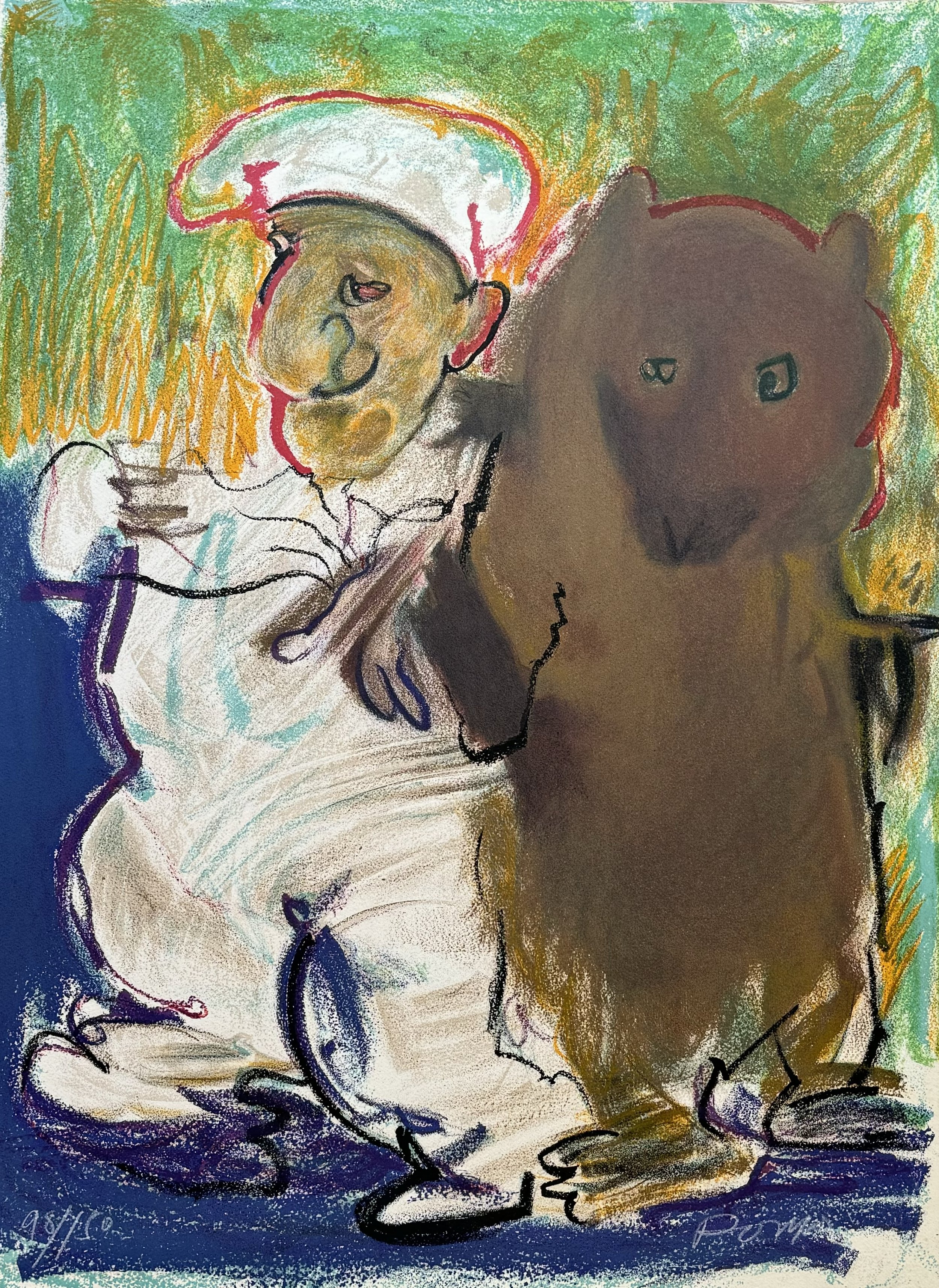
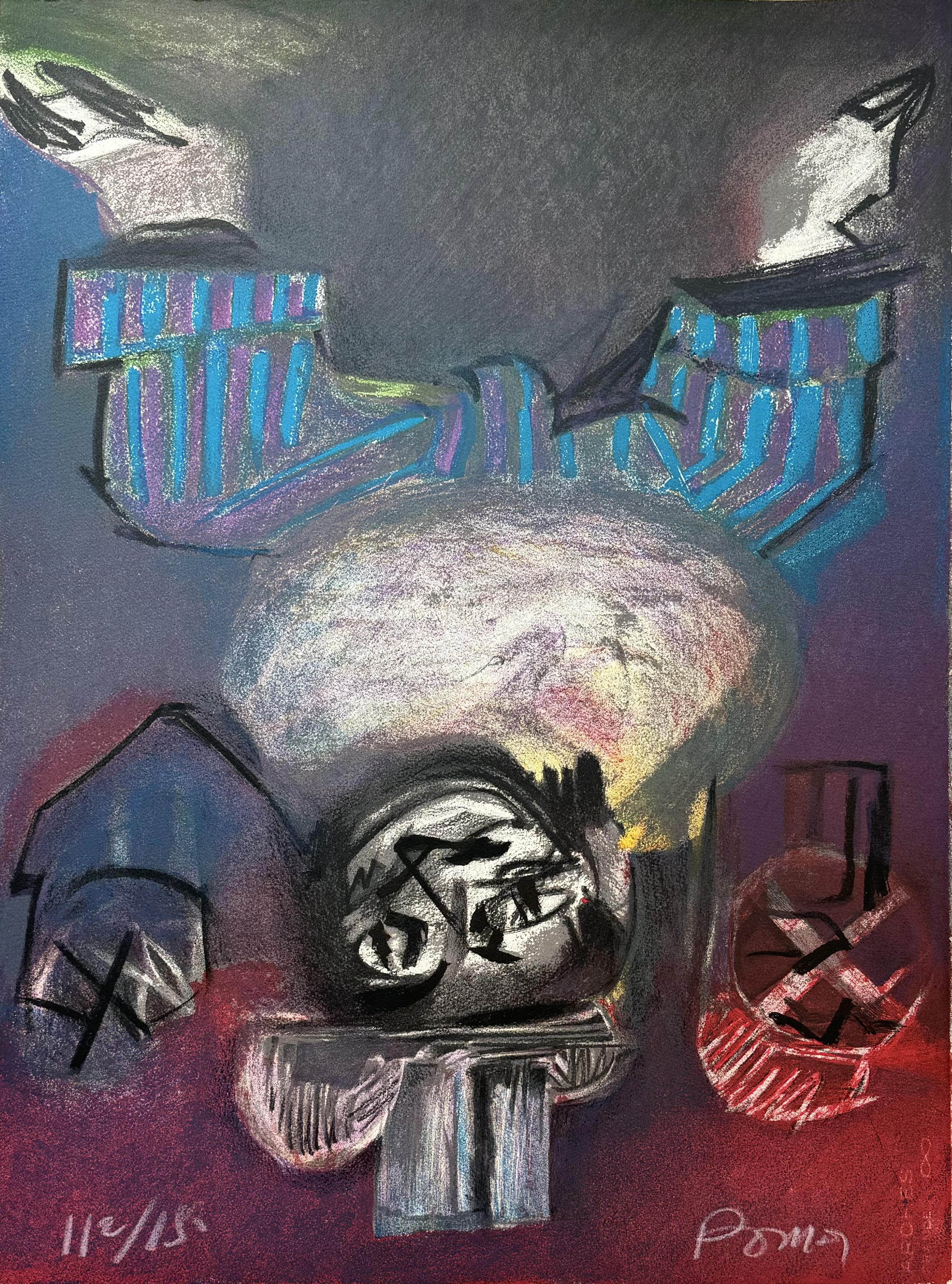
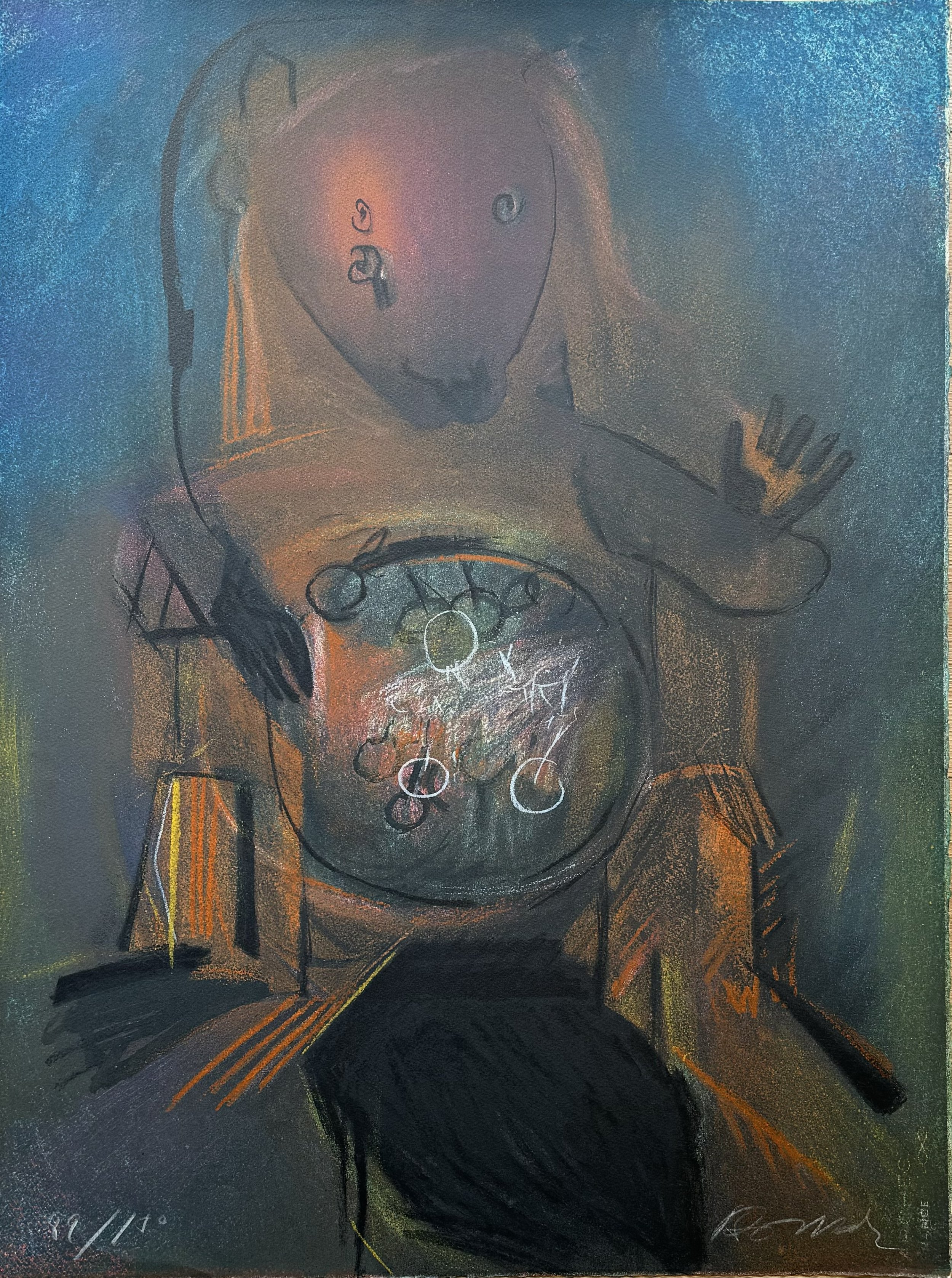
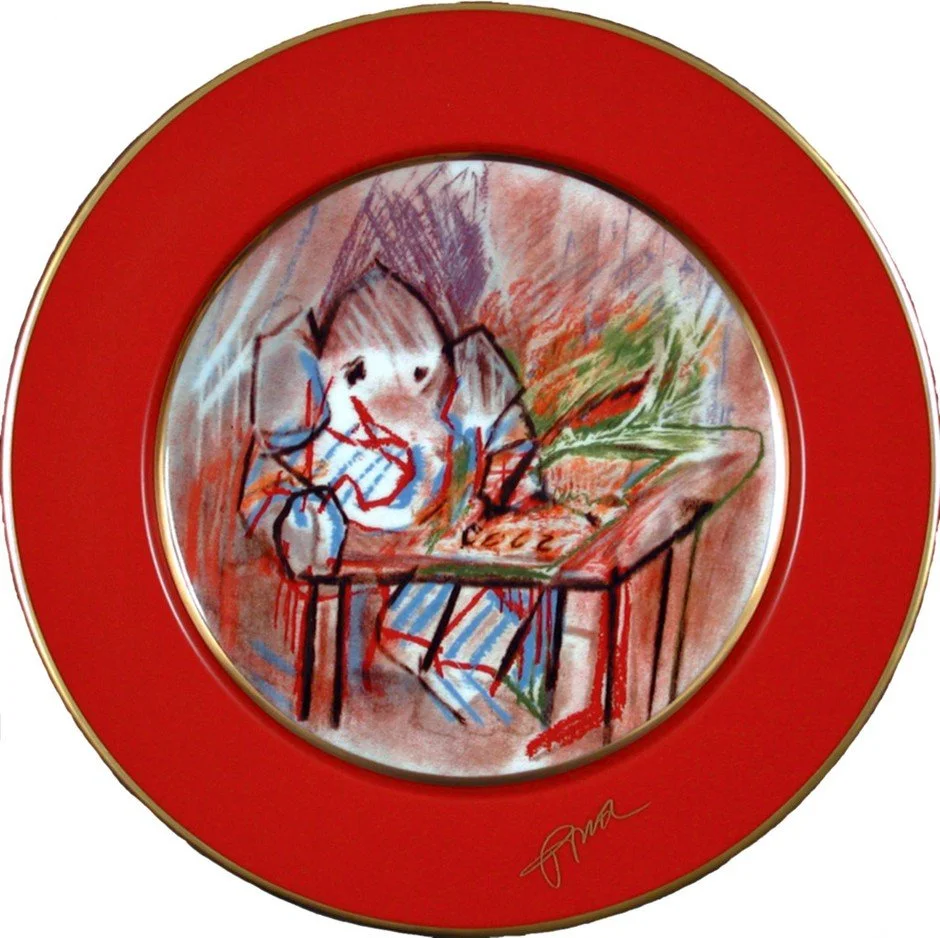
Series: Tigers
Screen-printed images and paper applied to fabric mounted on cardboard
72 × 51 cm
102 × 81 cm, framed
Issue XLVII/LXXV
Signed and Numbered