
Pedro Calapez
He studied at ESBAL and established himself as a painter in the first half of the 1980s in exhibitions such as Depois do Modernismo and Arquipélago. Remaining outside the whirlpool of appropriation and scatological expressiveness that marked the so-called "return to painting", Calapez embarked on a path characterized by methodological rigor in which drawing is the foundational practice.
Producing paintings through incision, close to the tradition of printmaking, the artist is primarily interested in the pictorial/architectural treatment of space. Architecture is one of the organizing references in Calapez's work, but this architecture, scratched onto the surface of the support, presents contradictory paths, facades, or vanishing points, creating implausible landscapes. Architecture that points towards scenography, functioning as a stack of fragments whose theatrical appearance insinuates a space of representation. Calapez encompasses within the scenographic logic not only architectural references but sets of objects that could serve as props or stage objects. But this is a residual scenography, abandoned by the actors, the narrative, and the drama that once inhabited it.
Over the past decade, this architectural vocation materialized in a work like Muro contra muro (1994), where the painted panels are installed in the gallery in the form of corridors that directly determine the path and visibility conditions for the observer. The same type of gaze-controlling effect is revealed in a series of recent objects: open cubes, without a top face, with painted interior walls that appear as "painting boxes" trapping the space of the visible.
During the same period, a new line of work developed for the artist. The inclination towards textures and landscape creation is now expressed through the increasingly fluent practice of abstract painting, which delights in the pleasures of applying paint and managing color combinations. These paintings often take the form of panels that, by bringing together multiple elements to occupy the space of a wall, once again establish a privileged dialogue with the space and light that welcome them.
Source: Camões - Cooperation and Language Institute
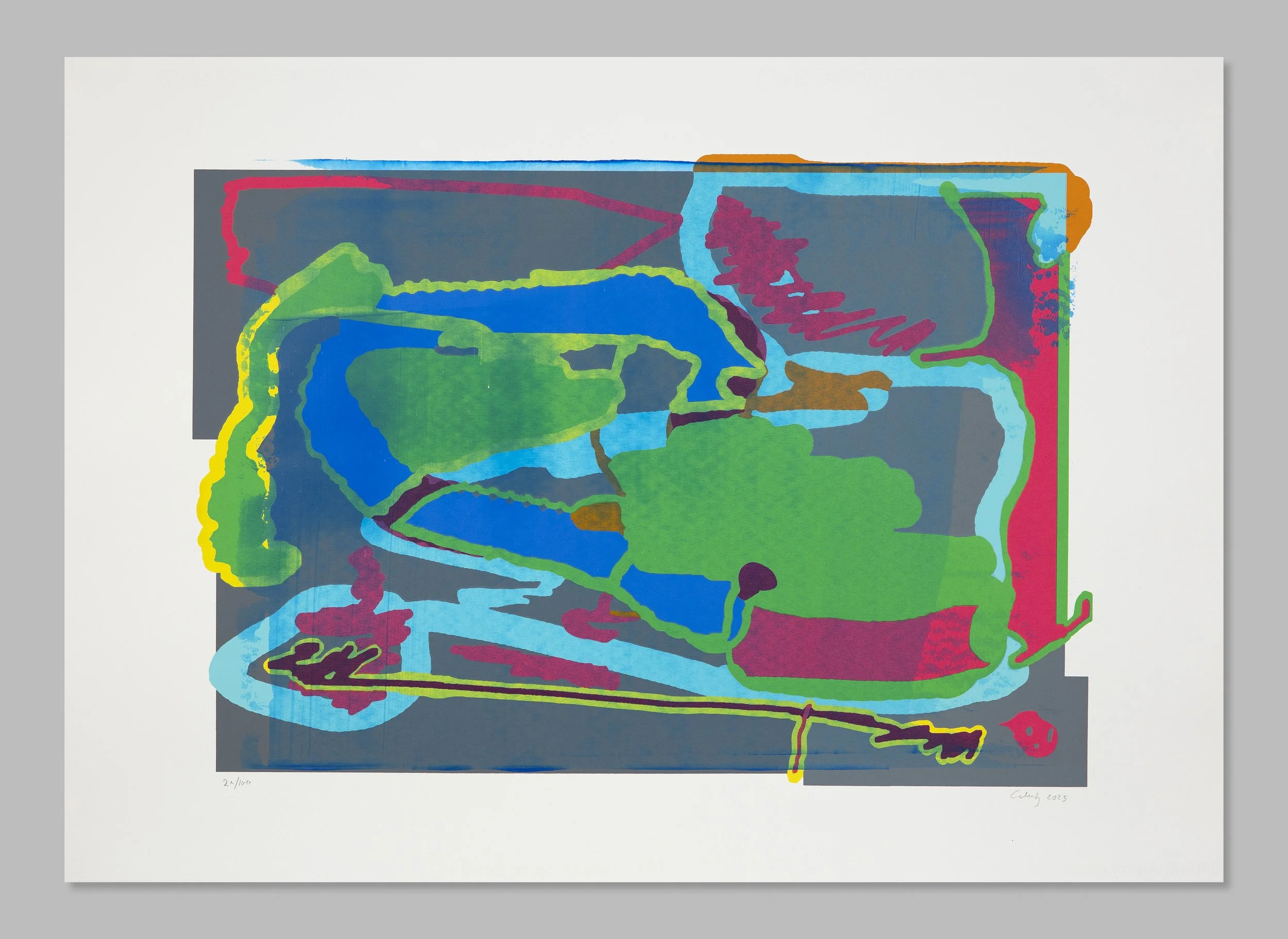
10-color modified screen print on Fabriano Tiepolo 290gr paper
53 × 77 cm, stain
70 × 100 cm, frame
90 × 120 cm, framed
Edition /100
Artwork framed with Tru Vue®-certified museum-grade glass